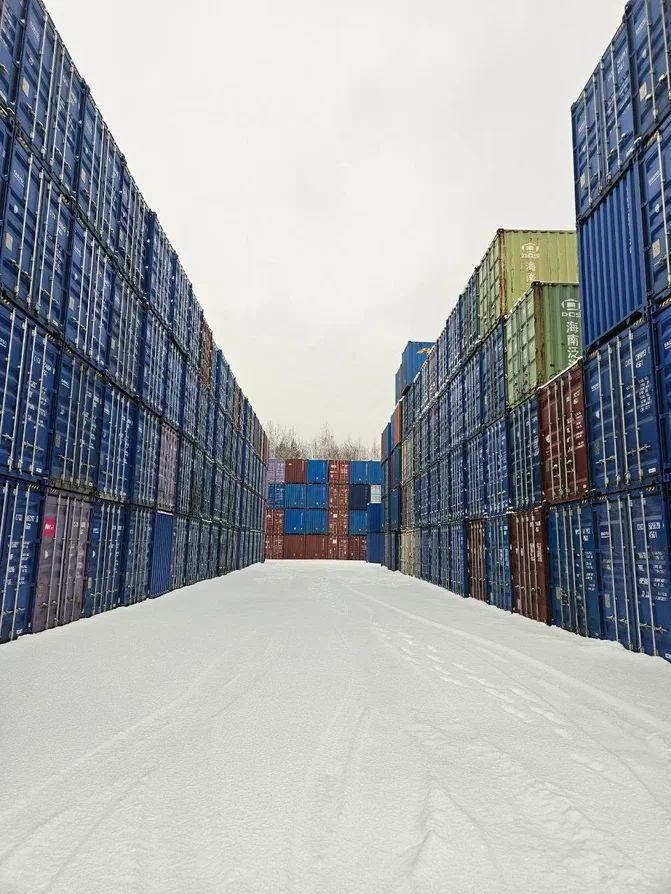


 Borisov, Brat'yev Vaynrubov, 39
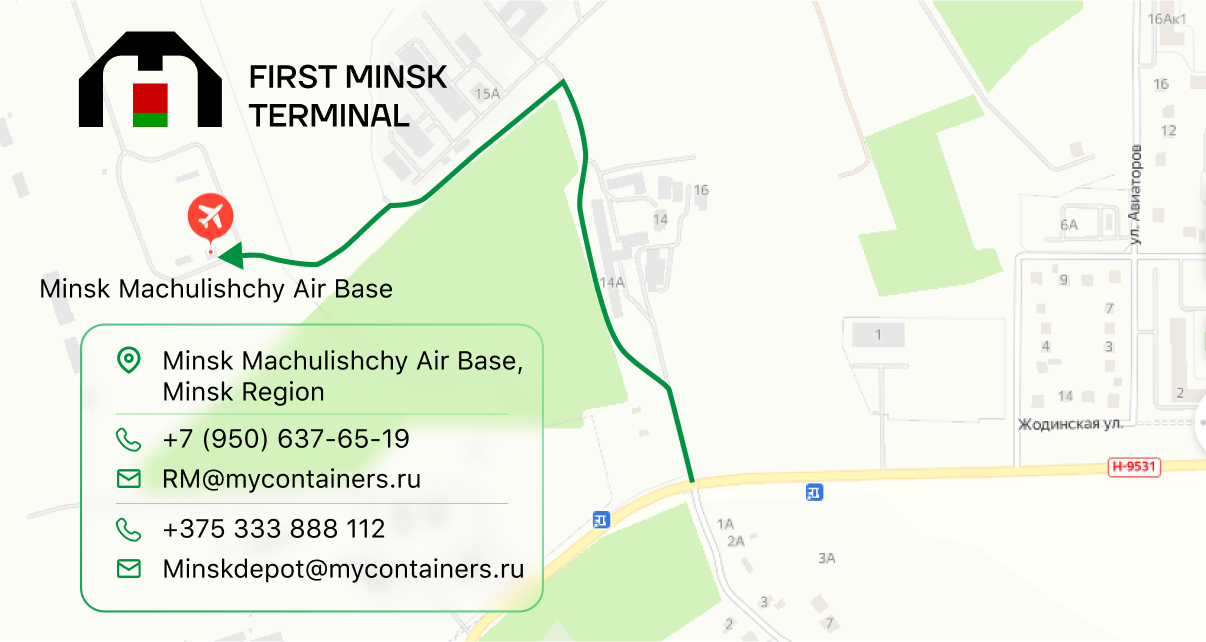 Minsk Machulishchy Air Base, Minsk Region
The development of the International Transport Corridor (ITC) "North–South" has moved from the discussion stage to the phase of concrete infrastructure solutions. One of the most notable recent projects is the launch by Belarusian Railway (BelZhD) of the regular block train "Slavic Caravan", connecting Belarus with Uzbekistan.
For logistics professionals, exporters, and manufacturers, this is not just another route. It means guaranteed slots, a fixed schedule, and priority passage through border crossings. However, working with regular block trains on the 1520 mm gauge network has its own strict specifics. Let's take a detailed look at how this route is structured, what requirements it imposes on cargo, and how to prepare a container for shipment.
What is the "Slavic Caravan" and Route Geography
The "Slavic Caravan" is a branded regular block train formed in Belarus and following a unified schedule to destination stations in Uzbekistan (primarily Tashkent).
Key features of the route:
Geography: Belarus (formation stations, e.g., Minsk or Zhodino) → transit through Russia → transit through Kazakhstan → Uzbekistan.
Block train status: The train is formed at a single station and travels to the destination station without being broken up at hump yards. This eliminates the delays typical of single-wagon shipments and reduces the risk of cargo damage from shunting impacts.
Speed: Thanks to priority clearance on the infrastructure of BelZhD, RZD (Russian Railways), and KTZ (Kazakhstan Temir Zholy), transit time is reduced by 20–30% compared to standard mixed freight trains.
Capacity and Technical Parameters of the Train
Block trains are formed according to strict standards to ensure even load distribution on the railway track and safe movement.
Number of wagons: A standard consist comprises 60–64 container flatcars.
Capacity in TEU: The train can accommodate 60 to 70 TEU (20-foot containers) or 30–35 FEU (40-foot containers), depending on the loading scheme and flatcar type (four-axle or six-axle).
Backhaul loading: The route operates in both directions. This is critical for the economics of the transportation: the train carries Belarusian or Russian goods to Uzbekistan, and on the return trip, it delivers Uzbek cotton, fruits, textiles, or chemical products, allowing operators to offer competitive freight rates.
Strict Requirements for Containers, Cargo, and Weight
Railway operations leave no room for calculation errors. Overloading or faulty packaging will result in the container being removed from the train at an intermediate station, leading to fines and missed deadlines.
1. Container Requirements
Type: Standard 20-foot (20’ DC) and 40-foot (40’ DC / 40’ HC) shipping or railway containers are permitted.
Documentation: A valid CSC plate (Convention for Safe Containers) is mandatory, even for overland transportation. This is an international safety standard.
Condition: The container must be weather-tight (pass a light test), with functional corner fittings and locking mechanisms. Missing floors or critical wall deformations are unacceptable.
2. Weight Restrictions (Critically Important!)
The load-bearing capacity of tracks and bridges on the Russia–Kazakhstan section is strictly regulated.
For standard four-axle container flatcars, the maximum payload capacity is approximately 60–63 tons (including the weight of the flatcar itself).
This means the gross weight of a 20-foot container must not exceed 28–30 tons.
The gross weight of a 40-foot container on a standard flatcar is also limited to 30–31 tons.
Important: Exceeding this limit requires the use of specialized six-axle flatcars, which must be requested in advance and are more expensive.
3. Cargo Placement Requirements
The center of gravity of the cargo must be strictly in the center of the container. Any shift (especially longitudinal) during sudden train braking can lead to deformation of the container's end walls and damage to the fittings. The cargo must be securely blocked and braced inside using wooden dunnage, straps, or dunnage bags.
Customs Procedures: Export or Transit?
Uzbekistan is not a member of the Eurasian Economic Union (EAEU). Therefore, customs clearance depends on the origin of the goods.
Scenario A: Export from Belarus (or Russia)
If the goods are produced in Belarus or have already been released for free circulation in the EAEU, an export Goods Declaration (GD) is filed.
Procedure code: Export (10).
Documents: Contract, commercial invoice, packing list, certificates of origin (ST-1), and permits (if the goods are subject to control).
After crossing the Uzbek border, the cargo undergoes import clearance according to local rules.
Scenario B: International Transit
If the container arrived in Belarus from Europe or another third country and is transiting to Uzbekistan, the customs transit procedure applies.
A transit declaration is filed.
The container is sealed with customs identification devices (seals).
During transit through Russia and Kazakhstan, delivery guarantees apply (or the TIR/MDP procedure, if applicable to a specific section, although for rail, the internal EAEU guarantee system and international agreements are more commonly used).
In both cases, it is critically important to accurately specify the HS code, gross weight, and net weight. Discrepancies with the data obtained during weighing at the terminal will lead to train delays.
Contacts for Rate Calculation and Organizing Container Shipment to Uzbekistan:
Terminal addresses: Minsk region, Machulishchi airfield, Aerodromnaya str. 15A; Borisov, Bratyev Vainrub str. 39.
Dispatch service: +375 333 888 112
Email: Minskdepot@mycontainers.ru
Client Manager (Vladislav): +7 (912) 251-37-46 (WhatsApp, Viber), bv@mgcorporation.org
*The information on this page does not constitute a public offer.