Borisov, Brat'yev Vaynrubov, 39
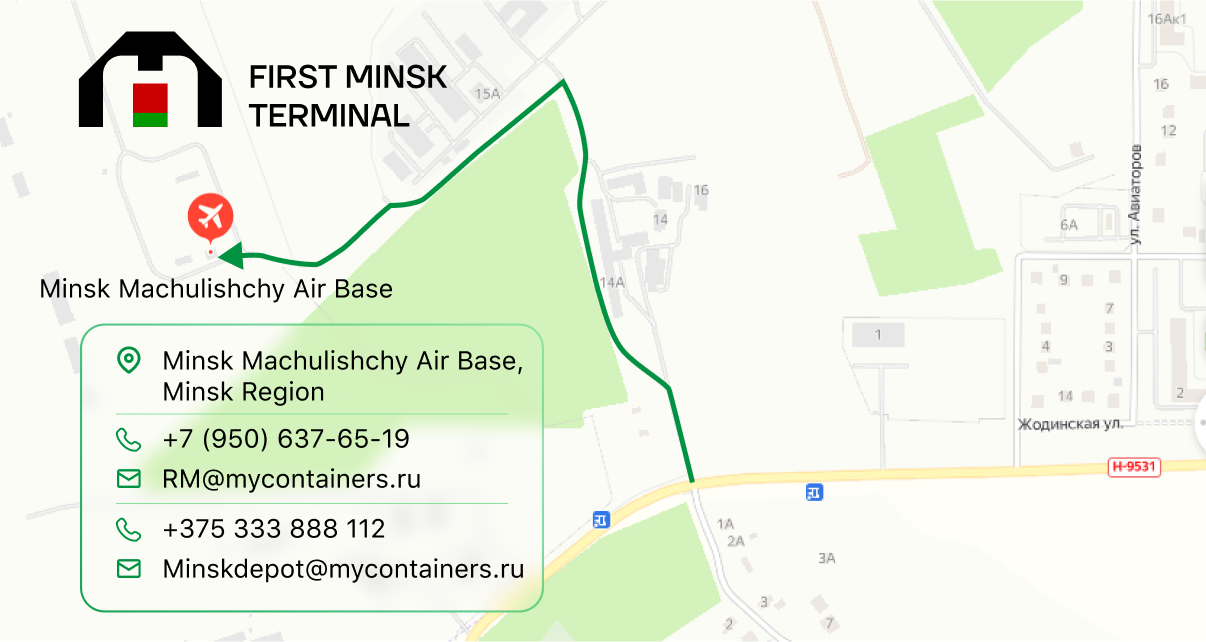 Minsk Machulishchy Air Base, Minsk Region
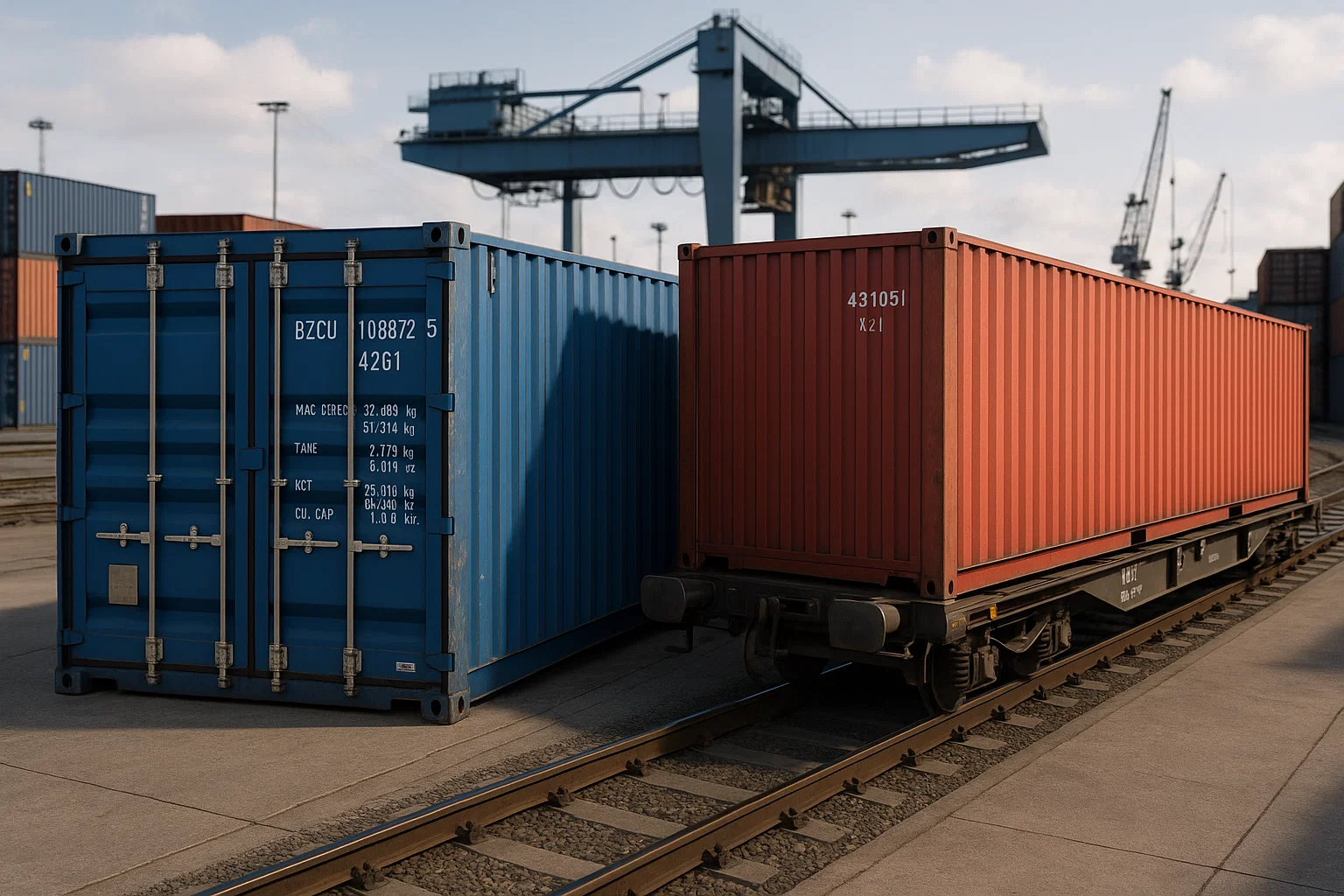
To the average person, any steel box measuring 6 or 12 meters is just a "container." However, in professional logistics, confusing Sipping and railway equipment can lead to shipment failures, refusal of vessel loading, or hefty fines.
The main paradox of container shipping is this: any Sipping container can be placed on a railway flatcar, but not every railway container can be loaded onto a sea vessel.
In this article, we will break down in detail the differences in standards, dimensions, payload capacities, and structural features of containers used on water and on land, and how this affects logistics to Belarus.
1. Standards: Global ISO vs. National GOSTs
Sipping containers comply with a single international standard, ISO 6346. This is the "Esperanto" of global logistics. Wherever you are—in Shanghai, Novorossiysk, or the Kolyadichi terminal in Minsk—the dimensions, corner casting placement, and markings of a Sipping container will be identical. This is necessary so the container fits perfectly into the cell guides of container ships, onto truck chassis, and under port crane spreaders.
Railway containers fall into two categories:
Intermodal (ISO): The exact same Sipping containers, simply transferred from a vessel to a fitting flatcar.
Domestic (National): Containers built specifically for the rail networks of specific countries (e.g., Russian Railways in Russia/CIS, China Railway in China). They are regulated by national standards (such as GOST 33068-2014) and may have dimensions that are physically unSuitable for sea vessels or European roads.
2. Dimensions and Capacity: The Pallet Wide (PW) Phenomenon
This is one of the most noticeable differences for cargo owners, especially when transporting palletized goods (FMCG, electronics, building materials).
Sipping Standards: Classic 20' DC, 40' DC, and 40' HC. Their internal width is about 2.35 meters. Because of this, only 11 Euro pallets (1200×800 mm) or 10 standard pallets fit in a single row. Space is not always used optimally.
Railway Pallet Wide (PW): On the railways of Europe, Russia, and China, PW containers are widely used. Their external width is the same (to fit standard flatcars), but thanks to thinner walls, the internal width is increased to 2.42–2.45 meters. This allows Euro pallets to be placed in two rows, fitting up to 30 Euro pallets in a 40-foot container (compared to 25 in a Sipping one).
Extra-long railway containers: On domestic rail routes (especially in Russia and China), 45-foot, 48-foot, and even 53-foot containers are used. They cannot be placed on a sea vessel—they would not fit the deck width or the hold cell guides.
3. Payload and Weight Restrictions
Paradoxically, railways often allow heavier loads in 20-foot containers than sea transport.
Sipping Restrictions: The maximum gross weight of a Sipping 20' container is usually limited to 24–30 tons. However, in practice, port cranes, road transport regulations for heavy cargo (VGM), and chassis limitations often reduce the useful payload to 21–25 tons.
Railway Capabilities: A railway flatcar and track can withstand colossal axle loads. Specialized 20-foot railway containers (often called "heavy haulers" or Open Tops for bulk cargo) can have an authorized gross weight of up to 30.4 or even 32.5 tons. They are massively used to transport coal, ore, scrap metal, mineral fertilizers, and heavy equipment.
4. Construction: Corner Castings, Flooring, and Stacking Strength
Corner castings are the 8 steel blocks at the corners of a container, used by cranes to lift it and to secure it to transport.
Sipping containers have corner castings strictly standardized by ISO.
Many purely railway containers (especially older or specialized tank containers) may have bottom stops or specific fastening nodes designed only for fixtures on railway flatcars. On a sea vessel, such nodes are useless, and the lack of standard upper ISO corner castings makes vessel loading impossible.
Strength and Flooring:
Sipping containers are designed with the understanding that 7–9 more identical containers might be stacked on top of them in a ship's hold. Their roofs and corner posts have colossal stacking load strength. The floor is always made of thick Sipping plywood or bamboo, treated with insecticides. Railway containers often do not anticipate multi-tier stacking on flatcars (they travel in a single tier). Therefore, their roofs may be less rigid. However, floors in railway containers for heavy cargo are often made entirely of steel or reinforced to withstand forklift loads when loading 30-ton ingots or coils.
5. The Golden Rule of Intermodal Logistics
If you are planning a multimodal shipment along a Sea + Rail + Road route, you must use only standardized Sipping ISO containers.
Standardized ISO containers will arrive by ship at a port (e.g., Novorossiysk or Vladivostok), be loaded onto a Russian Railways fitting flatcar, travel to the Kolyadichi or Brest station, and then be delivered directly to your warehouse in Minsk or any city in Belarus by a container truck.
If you lease a domestic Russian railway Pallet Wide or 45-foot container, you can only transport it by rail and road within Russia/CIS. You will not be able to ship it by sea to China or Europe—the shipping line will simply refuse the booking due to non-compliance with dimensions and safety standards.
How We Help with Intermodal Transportation and Containers
We handle all stages of working with Sipping ISO containers in Belarus, ensuring seamless logistics:
Last-Mile Road Delivery: We pick up loaded Sipping containers (20' and 40') from railway terminals (Kolyadichi, Stepyanka, Brest, Orsha) and deliver them to your warehouse, factory, or production site. We select the transport (multilift or truck with trailer) strictly according to the dimensions and weight of your ISO container.
Buyback of Empty Equipment: After unloading imported goods, you are left with an empty Sipping container. Don't waste money returning it to the port. We buy back empty Sipping containers in conditions ranging from As Is to IICL directly at our depot in Minsk, with payment on the day of the transaction.
Selection Consultations: We will advise you on which type of Sipping container (DC, HC, Reefer) is optimal for your cargo to maximize payload and avoid issues during the rail and road stages.
All Payment Methods: Cash and non-cash payments, work with legal entities, and prompt document processing.
How to Order Container Delivery or Buyback?
Contact us for a cost calculation. We will select the optimal solution based on the weight, dimensions, and type of your container.
Phone: +375 333 888 112
Mobile: +7 (912) 251-37-46
Email: Minskdepot@mycontainers.ru
*Information on this page does not constitute a public offer.