

 Borisov, Brat'yev Vaynrubov, 39
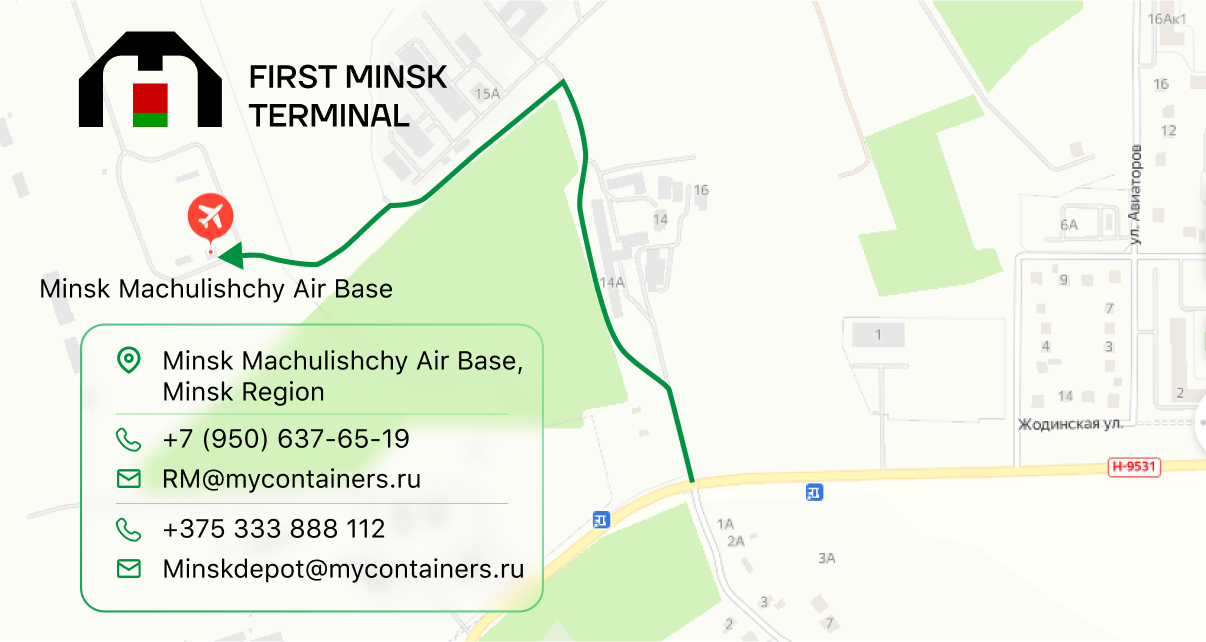 Minsk Machulishchy Air Base, Minsk Region

Any logistics professional working with the China–Europe route knows the unwritten rule: 80% of the time and 90% of the stress are spent not on transit across the vast expanses of Eurasia, but on one specific section just over 200 kilometers long. This is the junction of the Belarusian and Polish railway networks: Brest – Terespol.
Here, the broad gauge (1520 mm), used by trains from China and Kazakhstan, ends, and the European standard gauge (1435 mm) begins. This physical discontinuity creates the most famous "bottleneck" of the entire "New Silk Road" (China-Europe Railway Express). And it is precisely how operations are organized on the approaches to this border—primarily at the terminals in Minsk and its surroundings—that determines whether cargo reaches Germany or Poland in 14 days or gets stuck for three weeks.
Anatomy of the "Bottleneck": What Happens at the Border
When a train from China arrives in Brest, it cannot simply cross the border. European infrastructure physically cannot accept its flatcars. There are two main ways to solve this task:
Container Transshipment: Cranes lift containers from 1520 mm gauge wagons and place them onto European fitting flatcars. This is the most common and fastest method for mixed cargo, but it requires massive crane capacity and synchronized delivery of empty European flatcars.
Bogie Exchange: The wagon enters a special workshop, its body is lifted, the 1520 mm bogies are rolled out, and 1435 mm bogies are rolled in underneath. This method is ideal for refrigerated containers (to avoid interrupting the power supply) or specific cargo types, but it is technologically more complex and creates queues in the workshops.
During peak seasons (e.g., 1.5 months before Chinese New Year), the capacity of border stations is exhausted. Trains queue up. Every hour of downtime at the border is a direct financial loss for the operator and a missed deadline for the European consignee.
Minsk as a Strategic Buffer: How to Relieve Pressure on the Border
Experienced logistics operators have long stopped trying to "push" a container to the border in the hope of getting lucky. Instead, they use terminals in the Minsk region (Machulishchi, Borisov) as a preliminary logistics hub located just 200 km from Brest.
Moving the decision-making point from Brest to Minsk offers several critical advantages:
Pre-Clearance Customs: Instead of waiting in a live queue at the border, documents for the container are submitted electronically in advance while the train is still en route or standing at the Minsk terminal. By the time it approaches Brest, the transit declaration already has the status "release permitted." This reduces border control time from hours to minutes.
Quality Control and Pre-Trip Inspection (PTI): European railways and receiving terminals strictly check container conditions. If a container has a dented corner post or broken fittings, it may be rejected for transshipment. Minsk terminals have the time and infrastructure to conduct inspections, fix minor defects, and bring the container up to Cargo Worthy standards before it enters the border control zone.
Consolidation and Queue Management: The Minsk terminal acts as a buffer. The operator can gather containers from different shippers, form a uniform block, and apply for transshipment in Brest precisely within an agreed "window." This eliminates chaotic downtime of individual wagons on siding tracks.
Operational Efficiency at the "First Minsk Terminal"
We have structured our processes to ensure the seamless integration of the transit flow with border infrastructure.
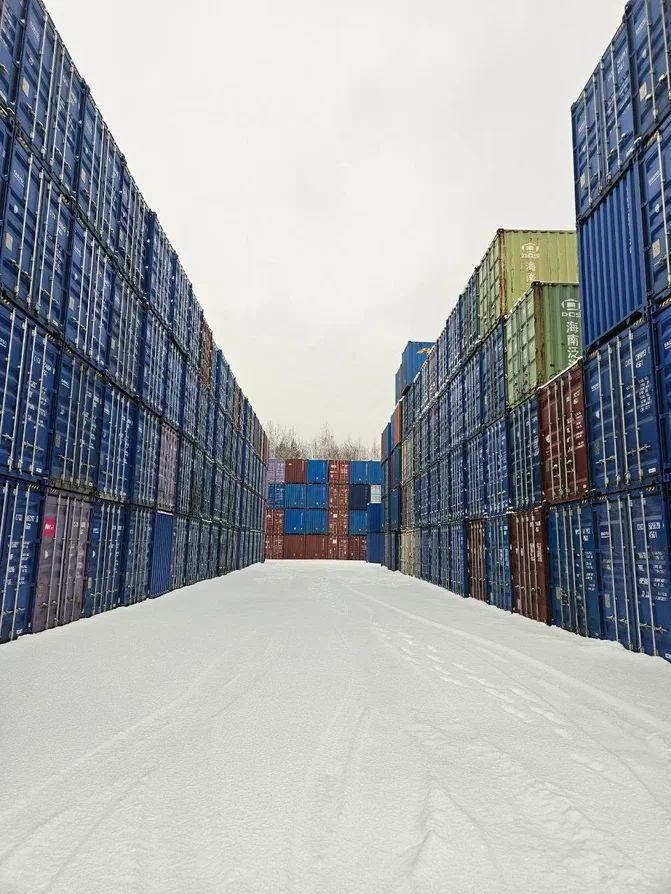
Direct Rail Network Integration: Our sites in Machulishchi and Borisov have their own dedicated access tracks. A container comes off the train and immediately enters the customs control zone (CCZ) or storage area, bypassing unnecessary maneuvers.
SKAT System: We track every container in real time. The client receives precise data: when the container arrived, whether it passed inspection, and if it is ready for dispatch to the border. This allows for surgical precision in planning logistics on the EU side.
In-House Crane Fleet: If transshipment from rail to road is required to send cargo to Europe by truck (which is often faster and more flexible than waiting for a rail flatcar), our reach stackers and gantry cranes perform this operation within 30–40 minutes of the vehicle's arrival.
The Economics of Time: Why 200 km to the Border Matters
The math is simple. The cost of storing a container at a specialized terminal in Minsk is a fraction of the demurrage and detention penalties imposed by European clients when deadlines are missed.
Furthermore, using the Minsk hub allows for risk diversification. If a force majeure occurs at the border (rule changes, peak congestion, technical failures), the container is in a secure, guarded zone with reasonable storage rates, rather than on an overcrowded public border track where access is restricted.
The "First Minsk Terminal" invites Chinese railway operators, European freight forwarders, and cargo owners to collaborate. We take over the management of the "last mile" of the broad gauge, turning the narrowest point of the "New Silk Road" into a predictable and controlled stage of delivery.
Contacts for Organizing Transit and Transshipment
Terminal Addresses: Minsk region, Machulishchi airfield, Aerodromnaya St., 15A; Borisov, Bratiev Vaynrub St., 39.
Dispatch Service: +375 333 888 112
Email: Minskdepot@mycontainers.ru
Client Relations Manager (Vladislav): +7 (912) 251-37-46 (WhatsApp, Viber), bv@mgcorporation.org